4900 California Avenue
Bakersfield, California 93309
Missed meal and rest breaks continue to be one of the most common and costly, wage and hour issues for California employers. A situation that comes up frequently is when an employee simply forgets to take a break. When that happens, many employers ask: Are we still required to pay a premium?
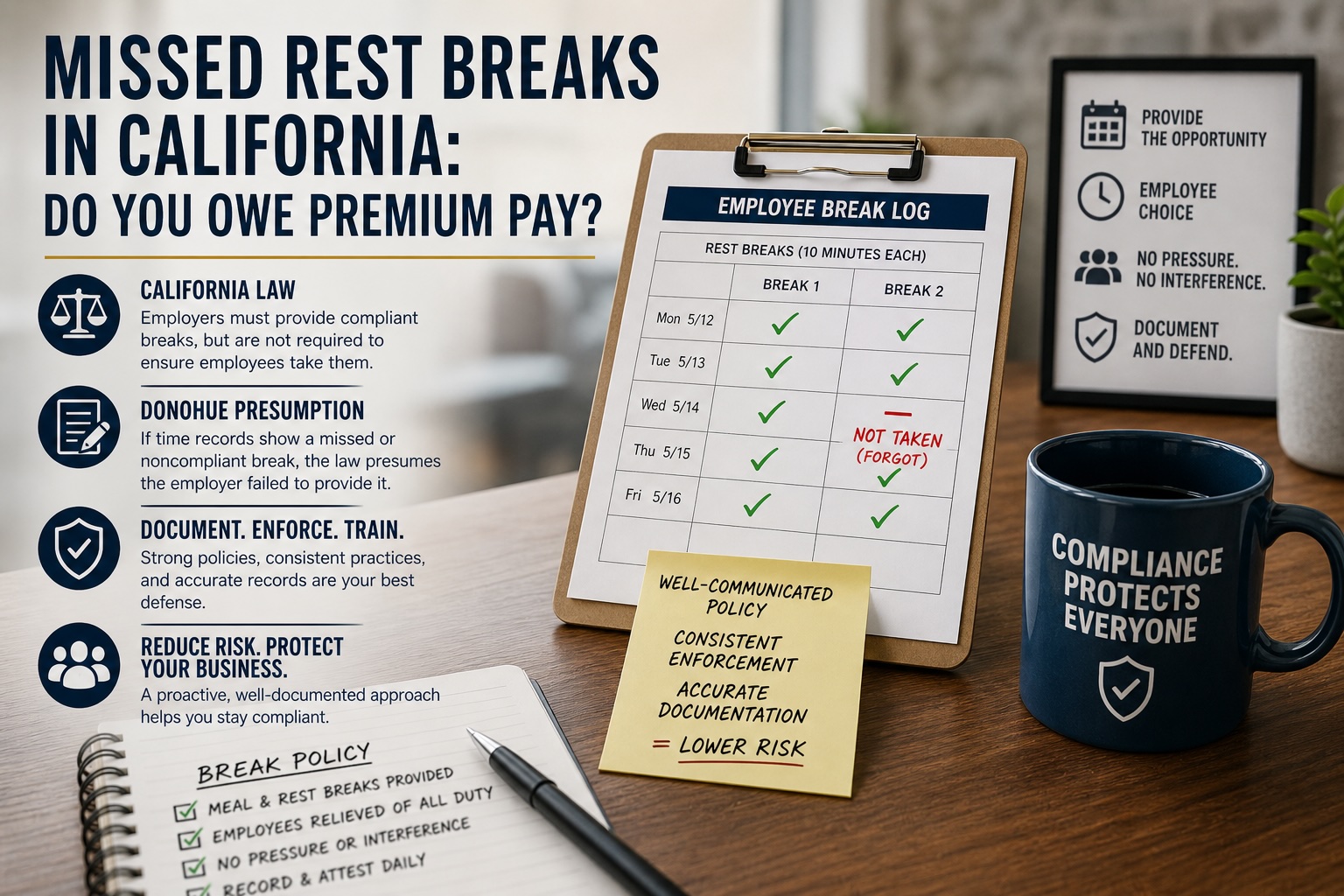
An employee does not record a second rest break on the company’s break log. When asked, the employee explains that they “forgot” to take the break. The company has a policy requiring employees to coordinate with a supervisor to ensure coverage before taking breaks.
At first glance, it may seem straightforward, but California law requires a closer look.
Under California law, employers are required to provide meal and rest breaks, but they are not required to ensure that employees actually take them.
This standard was clarified in Brinker Restaurant Corp. v. Superior Court, where the California Supreme Court explained that an employer meets its obligation when it relieves employees of all duty, gives them control over their time, provides a real opportunity to take an uninterrupted break, and does not discourage or interfere with that break. The same principles were later applied to rest breaks in Augustus v. ABM Security Services, Inc..
In other words, employers are not expected to “police” breaks. If a compliant opportunity is provided, the obligation is generally satisfied, even if the employee chooses not to take the break.
The challenge is not just what happened in practice—it is what your records show.
In Donohue v. AMN Services, LLC., the California Supreme Court established that when time records reflect a missed or noncompliant break, there is a rebuttable presumption that the employer failed to provide it. This means that a simple missing entry on a break log can create legal exposure, even if the employer did nothing wrong. In this scenario, the log showing the missed rest break could trigger that presumption.
Possibly, but it depends on your documentation and practices.
An employer may be able to rebut the presumption by showing that it had a well-communicated and consistently enforced break policy, that employees were expected to take and record their breaks, and that there was no pressure or interference preventing the break. It also helps to have a clear record—such as a written acknowledgment from the employee—confirming that the break was missed voluntarily.
Even with these safeguards, rebutting the presumption can be difficult. California courts tend to rely heavily on what is documented, and inconsistencies in enforcement or recordkeeping can quickly weaken an employer’s position.
From an HR standpoint, this is less about whether a premium might be avoided and more about how to reduce overall risk. Employers should focus on consistently enforcing their policies, training supervisors not to impede breaks (even indirectly), and maintaining accurate, real-time documentation. Many employers also use end-of-day attestations where employees confirm whether they were provided all required breaks, which can help strengthen compliance efforts.
If an employee forgets to take a rest break, a premium may not automatically be owed—but the employer must be able to prove that a compliant opportunity was provided. Without strong documentation and consistent practices, that can be a difficult burden to meet. For that reason, many employers choose to err on the side of caution and pay the premium when there is any uncertainty. Taking a proactive, well-documented approach is the best way to protect your organization in California’s highly regulated environment.