4900 California Avenue
Bakersfield, California 93309
When employers have multiple employees performing the same or similar jobs, it’s natural to assume they should all be classified the same way. However, when it comes to California wage and hour laws, that assumption can lead to costly mistakes.
A common question we hear is: If one employee qualifies as exempt, can we classify everyone in that position as exempt? The answer is no.
California law requires employers to evaluate each employee individually. Even employees with the same job title or similar responsibilities may not qualify for an exemption from overtime, meal and rest breaks, or other protections under California’s Industrial Welfare Commission (IWC) Wage Orders.
Many employers rely heavily on job titles or written job descriptions when determining whether a position is exempt. While these documents are important, they are only part of the analysis. California courts and enforcement agencies look at what an employee actually does on a day-to-day basis, not simply what their title says.
The most commonly used exemptions are the executive, administrative, and professional exemptions, often referred to as the “white-collar” exemptions. To qualify, an employee must satisfy both a salary test and a duties test.
For 2026, employees must generally earn a guaranteed annual salary of at least $70,304 to qualify for one of these exemptions. This salary must be paid on a true salary basis and cannot be satisfied through commissions, bonuses, or other variable forms of compensation.
However, meeting the salary requirement alone does not make an employee exempt.
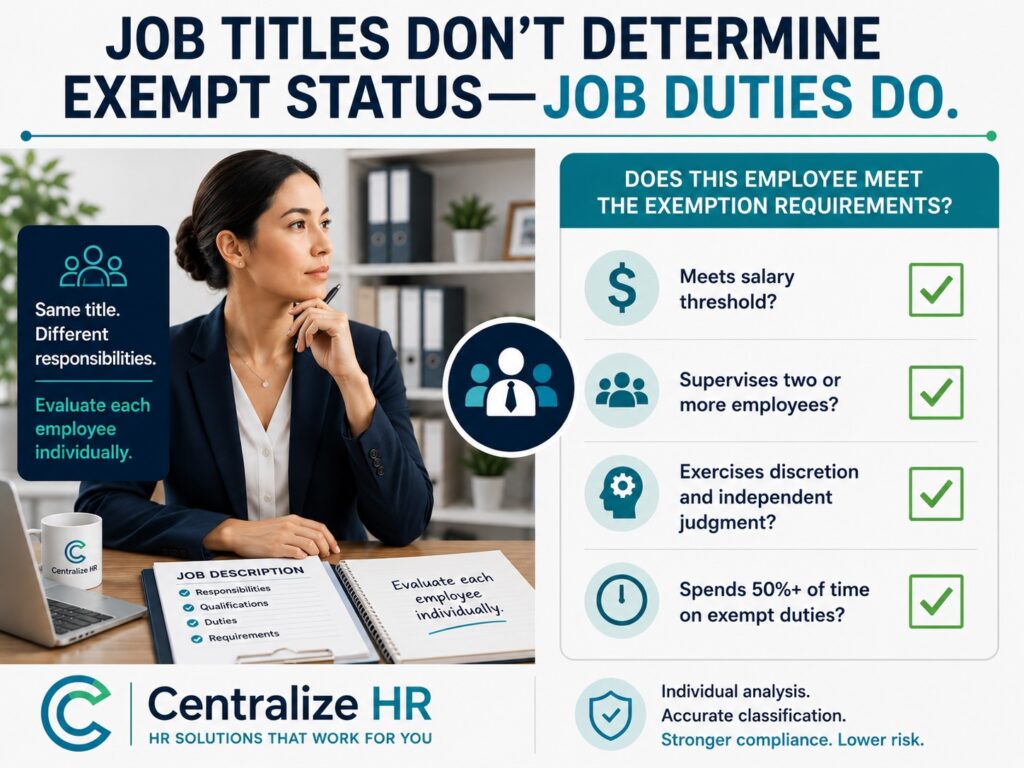
In addition to earning the required salary, employees must perform the specific duties required by the applicable exemption. For example, an executive employee generally must supervise at least two employees and regularly direct their work. Administrative employees must perform work related to business operations while exercising discretion and independent judgment. Professional exemptions apply to certain licensed or specialized professions, such as attorneys, physicians, engineers, certified public accountants, and teachers.
Regardless of which white-collar exemption is being considered, employees generally must spend more than half of their work time performing exempt duties and regularly exercise independent judgment when carrying out their responsibilities.
These requirements are evaluated based on each employee’s actual work—not the employer’s expectations or the written job description.
Two employees may share the same title and even report to the same supervisor, yet their daily responsibilities can differ significantly.
For example, one Operations Manager may spend most of the workweek supervising staff, making management decisions, and directing business operations. Another Operations Manager may spend the majority of the day assisting customers, processing paperwork, or performing routine administrative tasks, with only occasional supervisory responsibilities.
Although their positions appear identical on paper, only the first employee may satisfy the exemption requirements because exempt status depends on how work is actually performed.
This is why California requires employers to evaluate each employee individually instead of applying exempt status across an entire job classification.
California recognizes several additional exemptions, including those for computer professionals, licensed physicians and surgeons, outside salespersons, and certain commissioned inside sales employees. Each exemption has its own specific legal requirements, and like the white-collar exemptions, they must be evaluated on an employee-by-employee basis.
Employee duties naturally change over time as businesses grow, departments evolve, and responsibilities shift. An employee who qualified as exempt when hired may no longer meet the exemption requirements several years later.
For that reason, employers should periodically review exempt classifications, compare actual job duties to legal requirements, and ensure compensation continues to satisfy California’s salary threshold. Regular audits can help identify potential issues before they become costly wage and hour claims.
In California, exempt status is determined employee by employee, not position by position. Job titles, organizational charts, and standardized job descriptions are helpful tools, but they are not enough to establish an exemption. Employers must evaluate each employee’s actual duties, level of responsibility, and compensation to ensure the exemption requirements are truly met.
Given California’s strict wage and hour laws and the significant penalties associated with employee misclassification, taking the time to conduct an individualized analysis is one of the best ways to reduce legal risk and maintain compliance.
Centralize HR partners with California employers to review exempt classifications, conduct wage and hour audits, evaluate job descriptions, and ensure compliance with California employment laws. If you’re unsure whether your exempt employees meet the legal requirements, our team can help you assess your workforce and reduce the risk of costly claims before they arise.